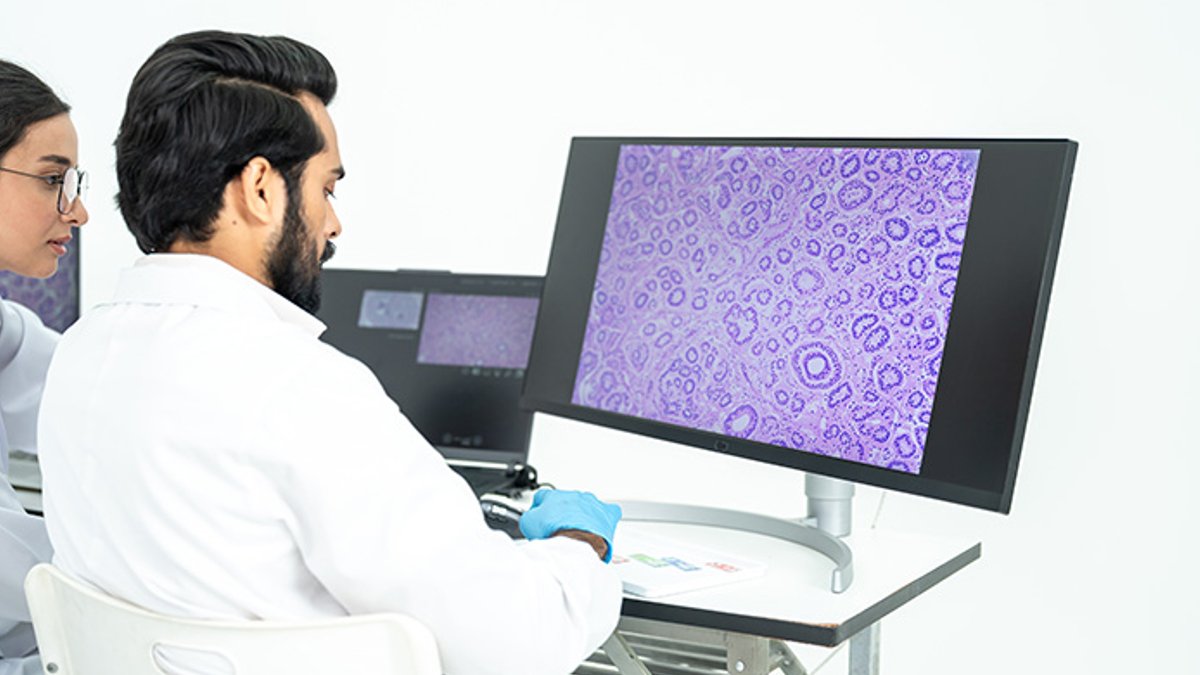
Traditionally, the default path of slides was something like a one-way street. A pathologist read a slide, wrote down the main findings, and after that, the glass went into storage. With the advent of digitization, however, these slides can now be transformed into permanent digital records, enabling researchers to uncover patterns associated with molecular changes in tissue. In April 2024, Charles River Laboratories, a leading global provider of preclinical research services, initiated its Alternative Methods Advancement Project to investigate how this data can be utilized to address questions that arise after a study has concluded.
Creating virtual control groups
Charles River Laboratories aims to reduce animal usage by leveraging historical data instead of maintaining separate control groups. Typically, in toxicology studies, a concurrent control group is handled identically to the test group but does not receive the drug. By replacing some of these physical controls with matched historical data, the number of animals required can be significantly reduced through simple arithmetic. Nevertheless, using historical controls necessitates establishing that the earlier animals and study conditions are sufficiently comparable to provide a reliable baseline.
The team at Charles River Laboratories is working on generating sufficient matched data to provide virtual controls wherever possible. This approach relies on the same formalin-fixed, paraffin-embedded (FFPE) blocks used to create the original slides. Researchers can then compare the additional molecular findings with the original dosing information, tissue observations, and control data to extract more from the same animals, from the same blocks, without running a new experiment.
Read Also: Big Tech Matches Pharma’s Top 10 in R&D Spending
Archived tissue blocks can retain molecular information about how tissue responded to treatment. Collecting fresh-frozen tissue for molecular analysis typically requires planning before a study commences. When a question arises after a study has concluded and suitable samples are unavailable, researchers may need to conduct another animal experiment. By utilizing FFPE material from previous studies, labs can investigate gene expression and proteins without losing the context of the original study.
Utilizing archived samples to minimize additional animal experiments
The Organisation for Economic Co-operation and Development’s 2025 guidance on sample collection for omics analysis outlines how preserved tissue can support molecular investigations, including studies of gene expression and proteins. The document emphasizes that sample preparation and storage affect the quality of the results.
Aleksandra Zuraw notes that this approach allows researchers to “extract more from the same animals, from the same blocks, without running a new experiment.” Using archived samples to avoid additional animal experiments fits into a broader regulatory push, which began with the FDA Modernization Act 2.0, enacted in 2022, allowing nonanimal methods to support applications for human drug trials.
Read Also: Hepatitis C cases rise in US despite cure
Novel methods for existing data sources
Aleksandra Zuraw highlights a series of parallel developments impacting the field, including molecular prediction from hematoxylin and eosin (H&E)-stained slides, an approach whose use is growing in medical diagnosis and research. She refers to it as “a big area of development,” explaining: “You take a data source, a digitized H&E image, you don’t even have to use other methodologies, and you apply new methods.”
A 2026 review documents the accelerating proliferation of applications across tissue types, tracing back to demonstrations in 2019. Most virtual staining still begins with a glass slide, where a scanner captures an unstained tissue section and software generates the appearance of a stain. Zuraw sees a wider cycle taking shape, where researchers find new uses for digital images, and labs have more reason to invest in the systems needed to create and share them. As she stated, “I hope it becomes a snowball effect,” opening up “data sources that aren’t new, but that we didn’t have a way to access before.”


Leave a Reply