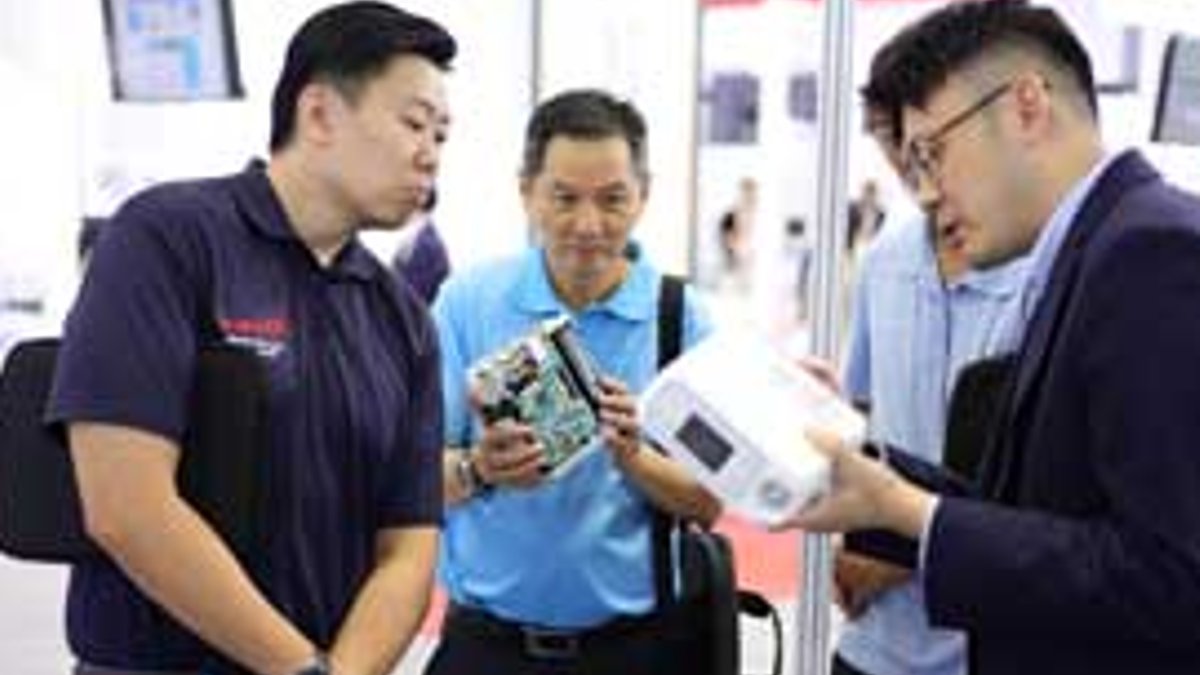
The three co-located events attracted 13,854 attendees from 73 countries, alongside 1,000 exhibitors from 40 countries. Highlights included Singapore General Hospital’s PEACH chatbot for pre-surgery assessment and discussions on manufacturing, cybersecurity, and market access.
AI and Robotics Take Center Stage in Healthcare Innovation
Singapore General Hospital presented its PErioperative AI Chatbot (PEACH), designed to streamline pre-operative assessments for a clinic handling 120 patients daily. Meanwhile, Quanta Computer explored continuous monitoring through wearable and ambient sensing across hospitals and homes.
The Innovation Partner Showcase featured emerging technologies from SUTD, the NUS Biorobotics Lab, and Singapore Polytechnic, including wearable rehabilitation technologies, lightweight exoskeletons, and AI-enabled healthy aging solutions.
At RehaCare Asia, the focus shifted to rehabilitation beyond hospital walls. St Luke’s Hospital and Robotimize signed a memorandum to integrate rehabilitation robotics into clinical practice. Adjunct Associate Professor Dr. Loh Yong Joo emphasized the need for rehabilitation to continue in the community, highlighting the potential of robotics to reduce physical demands on therapists.
Challenges and Opportunities in Healthcare Technology Implementation
The ASEAN Care Readiness Index 2026 revealed a disconnect between healthcare ambition and practical implementation. While 94% of surveyed leaders felt prepared for the next three to five years, 54% cited technology implementation capability as a barrier.
ASTAR SIMTech / AIMfg discussed barriers to scaling AI, including fragmented data and complex manufacturing environments. The ASTAR Innovation Factory emphasized the importance of bridging the gap between prototypes and manufacturable products.
Looking ahead, the co-located events demonstrated the interconnectedness of clinical needs, technology development, and manufacturing expertise. The debut of RehaCare Asia extended this focus to rehabilitation and community care, setting the stage for future editions in Bangkok and Singapore.
Read Also: Blood Test Can Classify Small-Cell Lung Cancer Subtypes
These events show that technology must fit clinical workflows, support healthcare professionals, and be viable to manufacture and scale.”
Manufacturing and Market Access: Bridging the Gap Between Innovation and Implementation
These include determining whether to build capabilities internally, outsource, partner, or acquire. The message was clear: a great technology does not automatically translate into a great product.
Market Entry Briefings addressed additional challenges for companies expanding across the region, such as regulatory strategy, product classification, and the licenses required for manufacturing, importing, or distributing products. These factors significantly impact how and when a technology reaches individual markets.
Nelipak Healthcare Packaging Pte Ltd was awarded the 2026 Marketing Excellence Award, while Toki Automation Pte Ltd received the Special Recognition Award at the event.
Rehabilitation and Community Care: Extending Healthcare Beyond Hospital Walls
At RehaCare Asia, the focus was on integrating rehabilitation technology into patients’ lives and healthcare workflows. Speakers at the From Pilot to Practice forum emphasized that clinical efficacy alone is not enough for adoption. Factors such as patient goals, affordability, technical support, and home usability are equally important.
The Living Longer, Living Better Seminar, in collaboration with Frost & Sullivan, discussed the shift from episodic treatment to a connected care journey spanning prevention, diagnosis, acute care, rehabilitation, and community care. Technology was highlighted as a key enabler in decentralizing services and extending healthcare capacity.
A live patient demonstration of Locomotor Therapy in Practice showcased robotic gait training, body weight-supported treadmill training, and overground rehabilitation, illustrating the practical application of these technologies.



Leave a Reply